Thursday, May 4, 2017

St. Bernard


A St. Bernard is part of the working dog group and weighs between 140-260 pounds. St. Bernard dogs originated as guardians, herding, draft and hunting dogs in the Alpines. They are thought to be descendants of Molosser type dogs. A St. Bernard is a super friendly dog, but does require a lot of grooming, training and veterinary care. The smile rating is:
  •  Adaptability: J J J
    • Does not tolerate heat well
  • Friendliness: J J J J J
    •  Great with kids and animals!!
  • Grooming needs: J J J J
    • St. Bernards are shedders and droolers!
  • Health J J
    • They are susceptible to hip and elbow dysplasia, Osteosarcoma, entropion/ectropion, Dilated Cardiomyopathy, Cataracts, Allergies and Gastric Distension and Volvulus (GDV)
  • Train Ease J J
  • Exercise needs J J J


Picture from: http://www.newyorkhotelsmotels.info/quesinfo-saint-bernard-saint.html


Tuesday, May 2, 2017

DR. ALICIA’S NEWSLETTER
May 2017
Dr. Alicia Rueschhoff

Happy Mother’s Day and Happy Flowers J ! My monthly newsletters are available for tidbits of information regarding pet healthcare. My intention is to educate clients and enhance their relationship with me. I am hopeful this will aid you in keeping your furry family member healthy!  Please feel free to share these with your family and friends.

What to expect from our monthly newsletters:
1. Fact or Fiction? We will provide a “True” or “False” statement for your consideration. The answer will be in the next month’s newsletter.
2. New information regarding any recalls or other matters pertaining to your pet’s health.
3. Updates on new recommendations
4. Seasonal recommendations for your pet.
5. Behavior training recommendations for your pet.
6. Question of the month. One client’s burning questions will be answered by a veterinarian.
7. Pet of the month


FACT or FICTION:  
  • April: Cat’s always land on their feet.  
    • False. Although cats have developed several characteristics to help them land on their feet, there are times where these fail. The cat’s backbones are very flexible and cats do not have a collar bone. So, most cats are able to right themselves when falling a short distance, but many cats can get severely injured when jumping or falling from high distances.
Picture from: https://meowbox.com/blog/2016/4/cats-land-on-their-feet
  • May: Dalmatians are born without spots.
 Tune in next month to find out the answer for May. Let me know what you think on in the comments!


DID YOU KNOW?
Did you know that dog breeds with squashed faces (Brachycephalic) have a higher tendency for health problems?   
I agree that French Bulldogs, English Bulldogs, Boxers, Shih-Tzu’s, etc. are so cute and their personalities are hard to beat, but they could end up costing  you a lot more money. They generally have longer soft palates, everted laryngeal sacs, stenotic nares and decreased diameter of their trachea. This leads to a lot of breathing problems and can be life threatening in severe instances. They also seem more prone to allergies and other general health issues. Remember…I also recommend talking to a veterinarian prior to purchasing a dog and/or cat. This way you know what to expect before making such a huge commitment.
Picture from: http://dogsarena.net/blog/2015/04/08/pugnacious-or-brachycephalic-dog-breeds/

IMPORTANT MONTHLY INFORMATION
Products recalled in February
  • C.O. Truxton Inc. Phenobarbital Tablets 15 mg. These tablets may contain 30 mg instead.
  • Cocolicious Beef & Turkey Dog food. Presence of Pentobarbital (drug used for euthanasia). This company is Party Animal.

SEASONAL REMINDERS:
Mother’s Day! Mother’s day can lead to chocolate and plants lying around!
Remember that chocolate is toxic to our furry friends. Signs of chocolate toxicity are as follows:
  1. Vomiting/Diarrhea
  2. Hyperactive
  3. Shaking
  4. Seizure  
  5. Can lead to death.
Picture from: https://www.easyanimal.co.uk/community/dont-feed-dogs-chocolate-easter/#.WQjedtIrKUk

Here is a link to a list of toxic plant’s to our four legged family members:

Call me at Brentwood Animal Hospital (314-962-2900) or the Emergency Center right away (Our phone # 314-842-0403 or ACC # 314-822-7600) to see if your pet ate too much chocolate - This is if you are in the St. Louis area. The first thing to do is give Hydrogen Peroxide at 1 mL per pound (NO MORE THAN 45 mL PER DOG!) by mouth to try to induce vomiting. This does not take the place of calling us, as chocolate ingestion can be lethal.

BEHAVIOR:  CATS AND THE LITTER BOX

Picture from: http://www.petmd.com/cat/centers/litter/evr_why_multi_cat_households_need_multiple_litter_boxes

Do you have a cat that is not using the litter box correctly? This could be a medical issue or it could be a mental problem. Below discusses the necessary steps to take if this is a problem in your house:

  1.  First talk to your veterinarian. There may be tests that we recommend to rule out Urinary Tract Infection, urinary bladder stones, kidney problems, etc. It would be best to run a blood panel and urinalysis to get to the bottom line. 
  2. If the above has been ruled out, then it is either mental or Feline Lower Urinary Tract Disease (known as FLUTD).
  3.  Litter box number. You should have as many litter boxes as you do cats + 1 (2 cats = 3 litter boxes; 4 cats = 5 litter boxes). Even if there is a litter box that no cats use, studies show that this helps decrease unwanted “marking” behavior.
  4. Litter box location. You do not want all litter boxes in the same room. If in the same location, a cat will view that box as 1. You should also have a litter box on every level that the cat is allowed. This helps keep the boxes clean and a cat loves options!
  5. Litter box cleanliness. Make sure you are routinely cleaning out the clumped litter. You should be doing this 1-2 times a day if not more.
  6.  Hiding Places. Give your cat places to hide at home. This helps decrease stress. Get beds that are covered or cat trees.
  7. Routine. Cat’s LOVE routine, just like children. Feed them at the same time each day and keep bed time consistent for your cat. It is also a good idea to take 5-10 minutes a day (the same time daily) to play with your cat and give them 1 on 1 attention.
  8. Glucosamine. Glucosamine supplementation can help cats with FLUTD. It will help control the secondary bladder inflammation. I recommend Dasuquin Advanced. 
2  These are all the general tips I recommend. Let me know if these leaves any questions.


QUESTION OF THE MONTH

What is the best food to feed my pet?

Picture from: https://bestonlinepetstoreindia.wordpress.com/2014/11/26/royal-canin-excellent-cat-food-and-dog-food/
This question is animal specific – does your cat only stay indoors? Then they should be fed an indoor diet that is lower in calories. Is your dog highly active? Then they should be fed a diet higher in calories. Is your cat or dog a kitten/puppy? Then they should be fed a kitten and/or puppy diet (or all stages). However, there are some basic recommendations when it comes to food:

  • Make sure the diet is AAFCO certified. This means that it went through the recommended testing to make sure the food as the recommended nutrients that is needed.
  • The brands I recommend the most are Royal Canin, Hills and Purina Pro-Plan. I recommend staying away from Blue Buffalo and Wilderness diets.
Don’t hesitate commenting with any questions you have!!


PET(S) OF THE MONTH

There were no submissions for pet of the month for May.  PLEASE send us a picture or two with a small description of why your pet is so special! We would love to show them off!


Please send us a picture and a small paragraph about your pet to get them featured in our next newsletter. Send the information to dr.rueschhoff@gmail.com Attention PET OF THE MONTH.

Wednesday, April 19, 2017

Heartworm Prevention, is it really that important?


HEARTWORM PREVENTION
Is it really that important? 
https://blogger.googleusercontent.com/img/b/R29vZ2xl/AVvXsEgBFPmt3dgq2ioVYJ1ghp79-_j3cOxZWbJu0SppJHbudav0-K2vWqgUbC0WXNnpg2wBTrNuc_R6v1AZz_beD87PrIz66_sCKQ3VkDYB0SZ7defkJJ2Y-e9GaNROxBWTM_CgQT4bXXXSZpk/s1600/heartworm.jpg
Picture from: http://www.windmillvet.com/reminders/details/?ID=102

Since it is getting warmer out there, let’s talk about that common question...Is heartworm prevention really that important? I get asked this question on a daily basis and the answer is, YES!, with the explanation below.

HEARTWORMS, WHAT ARE THEY?

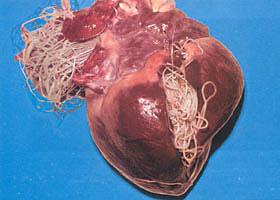
Heartworms, otherwise known as Dirofilaria immitis, are nasty internal parasites that reside in an animal's heart and pulmonary (lung) vessels. These critters can cause irreversible damage to your pet's heart, lungs and other organ systems and lead to death.

Dogs are the natural hosts for these parasites. However, there are several atypical hosts including cats, coyotes, wolves, foxes and even humans. Being the natural host means that the heartworms can reside for a long period of time and reproduce at an astonishing rate in that animal. Dogs have been known to harbor hundreds of worms in their heart and lungs. 

An atypical host can still be infected with the heartworms, but they usually do not reside there as long and do not reproduce at such a high rate. However, these atypical hosts are a great source of transmission. The immature worms living in these hosts can also cause significant damage to the animal's organ systems and can produce respiratory disease, otherwise known as HARD (heartworm associated respiratory disease). 

HOW ARE HEARTWORMS TRANSMITTED?

https://blogger.googleusercontent.com/img/b/R29vZ2xl/AVvXsEiiRlZUxYnjhr_K1ux4mxQfqCDqGkPOxWJUI3xmm9TbJViB2AMh4oqtKyIl3Wd_QRGRbCSOZvPq_widLEdCWK-qYdixCGQTVNNs4o10TXyz2YLfCMu1rqsqbotBcXNVCCOrIZG4Bj_T5HI/s320/heartworm.jpg


The transmission of heartworm can be explained with their life cycle. The first step of the life cycle starts with a mosquito taking a blood meal from an infected animal. This can be a natural or atypical host. The mosquito ingests a microfilariae (L1 - larvae 1), which then develops for an additional 10-30 days in the mosquito's gut (L2) before traveling to their mouths (L3). This infective larvae enters a dog or cat's body with an infected mosquito bite by sitting on the skin and easing its way into the skin (L4), migrating to the animal's heart and nearby vasculature. This is where they mate and start reproducing more microfilaria in a 6-7 month time frame.
https://blogger.googleusercontent.com/img/b/R29vZ2xl/AVvXsEh-t7ou_n6mGOLrTw-Tk4hGtHx6vNRfXL_VLWyVnY_AknE8HcGSkCfNoqF1A5CBHEsWMHwZPWmfi2f7UZYkkhaFSWBiSEVQasPl_T7OsddCcz-Z8aXfdeWY8nuDWCTolA9MHewmeV7MTx4/s200/heartworm+life+cycle.jpg


HOW MUCH RISK IS MY PET IN FOR HEARTWORM DISEASE?

https://blogger.googleusercontent.com/img/b/R29vZ2xl/AVvXsEgBpaz6MILGor85qkMplqtvzFN-Qg8NvQ4VbS7BO0nDkz6Wa-8wZv3lQXnKe3DnagWY4YWaHtByNcF6Y3W2u-HTfUf7y_3VXduz1NFBkDaNYvcv_d_LKOfeRmONtjF9ow0jrIhNBP6IjUc/s320/heartworm+incidence.PNG

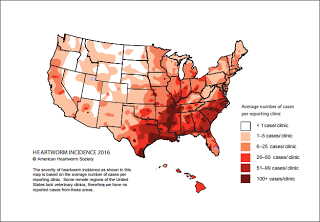
As you can gather from this map...heartworm disease is prevalent in most of the United States. Heartworm preventatives also de-worms animals for Roundworms, Hookworm +/- Whipworms (pending which preventative you choose). These nasty parasites can be found all over the United States as well, and can be infective through the winter months. It is always better safe than sorry.  

The map above shows the incidences that have been reported. Keep in mind that not every incidence is reported and some areas may be better at reporting them than others. Every year we see an increase in Heartworm disease and also see this map's red spreading. Just look at the map below comparing heartworm incidence from 2010-2013...this is only a difference of 3 years.


WHEN SHOULD YOUR ANIMAL BE TESTED FOR HEARTWORM DISEASE?

I recommend testing at 6-7 months of age, again in 6 months, and then yearly. This is best, since heartworm disease can take 6 months to show up positive. I also recommend retesting if your animal is off heartworm prevention, and again 6 months later. For cats, I recommend testing prior to putting on prevention. 

Heartworm disease is progressive and can become very serious. If we catch the disease early, then treatment will be much more successful and have a lot less negative side effects for your pet. Heartworm prevention is 98-99% effective, so, although unlikely, your pet can still get the disease. However, if you have proof of purchasing the prevention through a reputable pharmacy, and that your animal has remained on the prevention every month, then the company should refund you for the treatment. 

CLINICAL SIGNS OF HEARTWORM DISEASE

Dogs
The  most common presentation for dogs that test positive is a healthy dog coming in for their annual examination. This is because the worms have to develop and start causing damage before you will start seeing the symptoms of this disease. 
The most common clinical signs of heartworm disease in dogs are coughing, exercise intolerance, weight loss and decreased appetite. You will start noticing other signs of heart disease as heartworm disease progresses such as obtunded abdomen and labored breathing. Dogs can also develop Caval Syndrome. This is a life threatening form of heartworm disease that is caused by a sudden block of the blood leading to the heart. You will notice collapse, labored breathing, dark urine and pale gums. This is an emergency and requires an aggressive surgery to correct. 

Cats
Most of the clinical signs in cats are very similar to dogs - coughing, asthma attack-like breathing, weight loss and decreased appetite. They may vomit as well, have difficulty walking and may even faint. Unlike dogs, which are commonly asymptomatic, the most common presentation for heartworm disease in cats is sudden collapse and/or death. This is why prevention in cats is so important. 

WHAT HAPPENS IF MY PET HAS HEARTWORM DISEASE?

Dogs
When a dog first tests positive for heartworm disease, we will recommend re-testing and confirming that it is positive before starting the harsh treatment. We will also recommend testing for baby heartworms (microfilaria) and take chest x-rays to visualize the heart and lungs. This allows us to know how far the disease has progressed, and develop the correct treatment plan for your pet. 

One of the most important aspects of treatment is exercise restriction. Allowing your dog to be active during treatment increases the risk of dislodging the worms from the heart/lungs and clogging other parts of the venous system. This can lead to sudden death. Strict exercise restriction is needed for 3 months (the length of treatment). 
Treatment lasts for about 3 months. It consists of oral steroids (pending the test results mentioned above), oral antibiotics and intramuscular injections that cause soreness and pain at the injection site. I will send home pain medication, as well, for my patients. 

Once treatment is finished, your dog will need to be tested to make sure the heartworms are indeed gone, tested 6 months later, and then yearly as the general recommendation. 

The treatment can cost thousands of dollars, depending on how severe the case, and can do significant damage on your dog’s organ systems. This is why we stress heartworm prevention so strongly. 

Cats
Remember that cats are the atypical host for heartworms. This means that some infections can resolve on their own. However, it can still affect and damage the cat's heart and lungs. Because the lung burden is so low in the cat, it can be more difficult to detect. This is why we recommend testing for antibodies, antigens, and we may even have to recommend an x-ray, further lab work, or an ultrasound. 

Unfortunately there is no medication that is safe to use in cats that is specific for treating this parasite. The goal for feline treatment is to stabilize and keep them feeling good with anti-inflammatories and antibiotics, as needed. Your cat may, at times, require hospitalization. We always recommend starting on prevention as well, as there is a possibility that this can help decrease the worm’s strength. 

IS HEARTWORM PREVENTION REALLY IMPORTANT?
I hope I have answered your question and made you realize that, YES!, heartworm prevention is important. Not only in our dogs, but in our outdoor and indoor kitties as well. Mosquitoes fly inside as well as outside. Heartworm disease is so easily preventable, and prevention does not cause your dogs or cats any harm. However, treatment for heartworm disease is harsh, painful, and a very slow and sad three months for your pet. Please, please, please use year long prevention on your animal...they would be thanking you!! 
Picture from: http://cute.barkpost.com/good/these-before-and-after-adoption-pictures-of-dogs-will-make-eyes-wet/

Tuesday, April 11, 2017

Dr. Alicia's monthly Newsletter - APRIL

DR. ALICIA’S NEWSLETTER
April 2017
Dr. Alicia Rueschhoff


Happy Easter! My monthly newsletters are available for tidbits of information regarding pet healthcare. My intention is to educate clients and enhance their relationship with me. I am hopeful this will aid you in keeping your furry family member healthy!  Please feel free to share these with your family and friends.


What to expect from our monthly newsletters:
1. Fact or Fiction? We will provide a “True” or “False” statement for your consideration. The answer will be in the next month’s newsletter.
2. New information regarding any recalls or other matters pertaining to your pet’s health.
3. Updates on new recommendations
4. Seasonal recommendations for your pet.
5. Behavior training recommendations for your pet.
6. Question of the month. One client’s burning questions will be answered by a veterinarian.
7. Pet of the month


FACT or FICTION:  
  • March: A wagging dog = A happy dog
    Picture from: http://www.freekibble.com/you
    -might-be-wrong-about-what-your-dog-is
    -saying-when-he-wags-his-tail/
    • False
    • Perhaps the most common misinterpretation of dogs is the myth that a dog wagging its tail is happy and friendly. While some wags are indeed associated with happiness, others can mean fear, insecurity, a social challenge or even a warning that if you approach, you are apt to be bitten.
  • April: Cat’s always land on their feet.  


Tune in next month to find out the answer for April. Let us know what you think on in the comments!

DID YOU KNOW?
Did you know that I recommend Interceptor for your dog’s heartworm and intestinal parasites instead of Heartgard. But why?
  • Although Heartgard is a wonderful product, Interceptor is a medication that protects against another intestinal parasite called Whipworm. It also protects against Heartworms, Roundworms and Hookworms, just like Heartgard. You may not know this, but these types of heartworm preventatives protect against the month prior of heartworm infection. Therefore, since it is now April, the preventative you give this month protects your pup against microfilaria they may have picked up in March. Interesting, right??

IMPORTANT MONTHLY INFORMATION
Products recalled in February
  • Evanger’s, Against the Grain dog food that has potential pentobarbital medication. This medication is used for euthanasia.
  • Wellness Beef Topper for dogs because it contained beef thyroid hormone.
  • Blue Wilderness, Rock Mountain Recipe Dog Food for containing beef thyroid hormone.
  • Barnsdale Farms, Hounds Tooth and Mac’s choice Dog treat – Pig Ears recalled for Samonella contamination.


SEASONAL REMINDERS:
Easter! As Easter comes, so does candy! Remember that chocolate is toxic to our furry friends. Signs of chocolate toxicity are as follows:
  1. Vomiting/Diarrhea
  2. Hyperactive
  3. Shaking
  4. Seizure  
  5. Can lead to death.
Call me at Brentwood Animal Hospital (314-962-2900) or the Emergency Center right away (Our phone # 314-842-0403 or ACC # 314-822-7600) to see if your pet ate too much chocolate - This is if you are in the St. Louis area. The first thing to do is give Hydrogen Peroxide at 1 mL per pound (NO MORE THAN 45 mL PER DOG!) by mouth to try to induce vomiting. This does not take the place of calling us, as chocolate ingestion can be lethal.
Picture from: http://animal-animal-animal.blogspot.com/2013/03/easter-animals.html


BEHAVIOR:  Leash Aggression
Do you hesitate before taking your dog on a walk because you don’t want to deal with a feisty pet? Here are some behavior modifications to try the next time. Remember that this can take time, so do not give up.
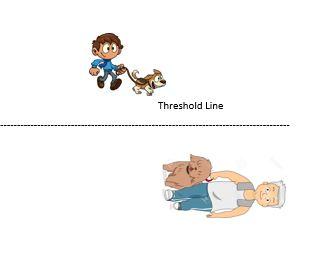
  1. Every dog has a threshold line. A threshold line is a distance away from the trigger of anxiety – be it another dog, squirrel, person, car, etc. Pay attention to this. Find out how close you can get to the object before your dog loses control.
  1. Every time you take your pup on a walk, bring their favorite treat – string cheese, turkey hot dogs, carrots, etc. Start giving these to your pet only when they are outside and calm. The next step is when you see a pet walking towards you, walk your pet to right before that threshold line, make them sit, give them a treat and walk the opposite direction; away from the stimulus. Eventually you can start making that gap with the threshold line smaller and smaller, then start walking on the same side of the street as the stimulus.
  2. The goal is to be able to have the stimulus stroll by while your pup is sitting, looking at you politely, waiting for their treat. ☺
  1. Another good idea is to use either a head harness, such as a gentle leader, or a front attaching harness. These restraints enforce your pup to look at you when being corrected.


QUESTION OF THE MONTH
In the month of February we asked if your dog needs heartworm prevention, but does your cat?
YES, YES, YES!!!! Even indoor kitties can get heartworm disease from infected mosquitoes. Being a person that regularly gets bitten, I can say with 100% confidence that mosquitoes will come inside to find a blood meal. Unlike dogs, we have no treatment for heartworm disease in cats. This makes prevention in cats even more important. I recommend Revolution once a month for ALL cats, indoor or outdoor. This product not only covers heartworms, but also roundworms, hookworms, fleas and ear mites. Call and order your Revolution today!!


Here is a link that goes over more information regarding this disease: https://www.heartwormsociety.org/pet-owner-resources/heartworm-basics  


PET(S) OF THE MONTH


There were no submissions for pet of the month for April.  PLEASE send us a picture or two with a small description of why your pet is so special! We would love to show them off!

Please send us a picture and a small paragraph about your pet to get them featured in our next newsletter. Send the information to dr.rueschhoff@gmail.com Attention PET OF THE MONTH.

Monday, April 10, 2017

We Vaccinate Your Dog Because We Care

We Vaccinate Your Dog Because We Care

Picture From: http://www.drsfostersmith.com/pic/article.cfm?aid=84

I was tagged in a post recently questioning a Veterinarian’s ethics on vaccine protocols for pets. The person’s post was as follows: “Let's talk rabies shots for dogs. I've read that one dose is good for the lifetime of your dog/cat. I also found no laws on this in the state of MO. I REALLY do NOT like shooting up my dog with crap that is not needed. Any Vets out there NOT taking my money that can give an honest answer to this? I do think a yearly exam is necessary, but can I refuse the rabies shot?”
I tried to respond, but the post was not made public for me to give her an educated response. I decided that I would use this as a topic on my blog, as I know it is controversial.
I first want to state that the MAJORITY of veterinarians DID NOT go into this business wanting your money. We went into this field because we LOVE animals and want them to have long and happy lives. The oath we take before graduating is as follows:
Being admitted to the profession of veterinary medicine, I solemnly swear to use my scientific knowledge and skills for the benefit of society through the protection of animal health and welfare, the prevention and relief of animal suffering, the conservation of animal resources, the promotion of public health, and the advancement of medical knowledge.
I will practice my profession conscientiously, with dignity, and in keeping with the principles of veterinary medical ethics.
I accept as a lifelong obligation the continual improvement of my professional knowledge and competence.
The amount of money we make vs. the amount of debt we take on after Veterinary school is insane! My student loans were a total of $250,000 and I make ~ ¼ of a human physician. I can only afford to pay my interest every year on my student loans; I did not go into this profession for the money.

Now to discuss why we give the vaccines we do:
  1. Core vaccines. These are vaccines that all pets need:
    1. Distemper combo. This vaccine protects your dog against Distemper, Parovirus and a number of respiratory viruses pending the combination of the vaccine.  Distemper is a virus that can cause either respiratory or neutolgic disease that has a very poor prognosis. Here are some links to show you what a dog with Distemper looks like: https://www.youtube.com/watch?v=a3sYiKS8tQU  https://www.youtube.com/watch?v=ld9YI-10gzg. You have likely heard of Parvovirus. This is a virus that will attack fast replicating cells, such as white blood cells and intestinal cells. This causes a severe GI disease in our animals (vomiting and/or diarrhea) and if not treated aggressively and rapidly can cause death.
    2. Rabies. The reason we do not see much Rabies in our pets’ is because we vaccinate. Rabies is still seen in the wildlife around our neighborhoods and is not something you want to risk. Here are some links on what Rabies looks like: https://www.youtube.com/watch?v=guYU1JDE_jM https://www.youtube.com/watch?v=H8fbAFOMTp4
  2. Non-Core Vaccines. These are vaccines given based on your pet’s lifestyle
    1. Leptospirosis. This is a vaccine that I treat as a core vaccine, but many veterinarians still give on an as-needed basis. Leptospirosis is a bacteria that is transmitted by urine from rats, raccoons, opossums, etc. (good luck keeping these critters out of your yard). It can remain in rain water, puddles and lakes for long periods as well. This bacteria causes severe liver and kidney failure in our pets and is something that humans can also become infected with. I have seen several animals die from this and I prefer to prevent it.
    2. Bordetella. This is a common cause of kennel cough. I recommend this vaccine for any dog that is going to be social – visiting parks with many other dogs, going to daycare, groomers or boarding facilities.
    3. Influenza. This protects against a severe respiratory disease. I recommend this vaccine for social dogs as well (see above). I practiced in Chicago during the H3N2 outbreak and let me tell you, I never want to see another pup with that virus every again. It is heartbreaking.
    4. Lyme. This vaccine I recommend for all dogs frequently visiting woody areas or hunting dogs. This disease is transmitted by ticks, most commonly the Deer Tick, which is out until it is 32 degrees outside.

Now to the science. Why do we give the same amount of vaccine to our Great Danes as we do to our Yorkie’s?

First off, there is a huge limit to the studies we get to run for veterinary medicine due to the lack of funds. The companies are required to prove that their vaccines are safe and effective in the species it is designed for. Most of these studies are done on the average dog.
Vaccines and medication work differently. Medications must reach an effective level in the blood and/or tissue so they can perform their function. Vaccines must stimulate the immune response, which is not measured by weight. And, in fact, there is a difference in doses based on the size of species. Dogs, cats and smaller pets = 1 mL; Horses and Cows = 2 mLs; Elephants = 2-4 mL. These doses have been studied and I can confidently tell my clients that their pet is protected. I do believe that half doses will likely protect our smaller animals, however this has not been studied. Therefore, if I vaccinate your dog with half the dose and they end up coming down with the disease you can legally sue me. I also must comply with the law on administering Rabies; giving ½ of the Rabies vaccine dose risks my license, which I cannot afford.
What I recommend to decrease vaccine reactions is split up the vaccines. Instead of giving a small dog the Rabies and Distemper on the same day, I ask the owner to come back in a couple of weeks and I’ll even waive the exam fee. This is because there does seem to be a correlation with the amount of vaccines given at a time and vaccine reactions.
Overall, vaccines are very safe. A 2002 study by VAAE found that 38.2 out of 10,000 pets had a reaction to a vaccine. I have also never had a vaccine reaction that I was unable to treat. I have, however, seen animals with Leptospirosis, Parvovirus, Distemper and Rabies that I was unable to help. My conclusion is that in order to keep your pet as safe as possible, I recommend vaccines according to the studies I have read. I treat your pet because I LOVE your pet.
The other option to vaccinating is titer testing. I do discuss this with people who are hesitant to recommended vaccinations. Titer testing checks to see if your dog and/or cat has enough immunity against the viruses in a vaccine and if your pet needs a booster or can go another year without one. The cost, however, is much more expensive than the vaccine. At our clinic, the Rabies Titer is $223 and the vaccine titer panel is $227 (this does not include the Rabies). So, if I really wanted your money this is what I would require every year. Instead, I recommend vaccinating for viral diseases every 3 years and bacterial disease every year.

I hope this can help you understand why we recommend what we do. We want your pet to live a long and happy life. We love animals.


References:
http://www.petmd.com/blogs/fullyvetted/2011/july/smaller_dog_smaller_vaccine-11432